
The auto and the market
Give directions, ask the fare, bargain for vegetables, count your change.
Meter haaki Please switch on the meter · मीटर चालू कीजिए
Learn spoken Kannada
Real, everyday Kannada — the way Bengaluru speaks it. A voice-first app: listen, repeat, speak with very little to read. For anyone who lives in, or is moving to, Karnataka, with Hindi support built in.
Works in your phone's browser — no app store, no card to start.
Kannada kali, Kannada nudi — learn Kannada, speak Kannada.
A little history
Kannada is a Dravidian language, a sibling of Tamil, Telugu and Malayalam, and it has been written for more than fifteen hundred years. Modern Karnataka took shape only in 1956, when Kannada-speaking regions from several states were brought together. Knowing a little of both makes the language feel less like a subject and more like a place.
Kadambas of Banavasi. One of the earliest ruling dynasties native to Karnataka. They helped establish Kannada in administration, and are associated with some of its earliest surviving inscriptions.
Chalukyas of Badami. Their cave and stone temples at Badami, Aihole and Pattadakal are landmarks of early Indian temple-building; Pattadakal is a UNESCO World Heritage Site.
Rashtrakutas. Ruling from Manyakheta, they were one of the great powers of their age, and patrons of Kannada letters.
Hoysalas. The intricately carved temples of Belur, Halebidu and Somanathapura, listed together by UNESCO in 2023.
Vijayanagara. Founded around 1336, it rose to become one of South India’s great powers. Its capital at Hampi, which flourished until 1565, is now a UNESCO World Heritage Site.
The Kingdom of Mysore. The Wodeyars shaped its history, while Hyder Ali and Tipu Sultan held power in the late 18th century. The Mysuru Dasara tradition was established under Raja Wodeyar I in 1610, continuing the celebrations of Vijayanagara.
One state. Kannada-speaking regions spread across several provinces were united as Mysore State. It was renamed Karnataka on 1 November 1973.
Kannada Rajyotsava — the state's formation day, when the red-and-yellow Kannada flag goes up across Karnataka. 2026 marks seventy years.
The Halmidi inscription. Generally regarded as one of the earliest surviving substantial inscriptions in Kannada, and a milestone in the language’s written history.
Kavirajamarga. A work on poetics from the Rashtrakuta court of Amoghavarsha I — the earliest Kannada literary work to survive.
Pampa, Ponna and Ranna. Celebrated as the “three gems” of classical Kannada poetry, they helped establish its great literary tradition. Pampa is honoured as the Adikavi, a pioneering poet of Kannada literature.
The Vachana movement. Basavanna, Akka Mahadevi, Allama Prabhu and others wrote vachanas — short, direct verses in everyday Kannada that questioned caste and ritual.
Dasa sahitya. Devotional songs by poet-saints such as Purandara Dasa and Kanakadasa. Purandara Dasa is honoured as a father of Carnatic music.
Eight Jnanpith Awards for Kannada writers, from Kuvempu to Chandrashekhara Kambara — among them D. R. Bendre, Shivaram Karanth, U. R. Ananthamurthy and Girish Karnad.
Classical language. The Government of India declared Kannada a classical language of India.
Dates for early inscriptions and texts are approximate and debated by scholars; we give the commonly cited ones.
Why learn it
Bengaluru runs perfectly well in English and Hindi — until it doesn't. A few dozen phrases change how the city talks back to you.
Give directions, ask the fare, bargain for vegetables, count your change.
Meter haaki Please switch on the meter · मीटर चालू कीजिए
Kannada has an informal “you” and a respectful one. Using the right one with an elder, a guard or a shopkeeper is noticed.
Hegiddeera? How are you? (respectful) · आप कैसे हैं?
The apartment gate, the lift, the milk delivery, the person who helps at home — small talk that turns strangers into neighbours.
Illi nillisi Stop here · यहाँ रोकिए
Colleagues, clients and the canteen. A greeting in their own language is a door English can't open.
Nanage swalpa Kannada barathe I know a little Kannada · मुझे थोड़ी कन्नड़ आती है
Kannada is part of school life across Karnataka. Learn alongside your kids instead of behind them.
Living somewhere is different from staying there. Kannada is how Karnataka feels like home.
Namaskaara Hello · नमस्ते
How the app helps
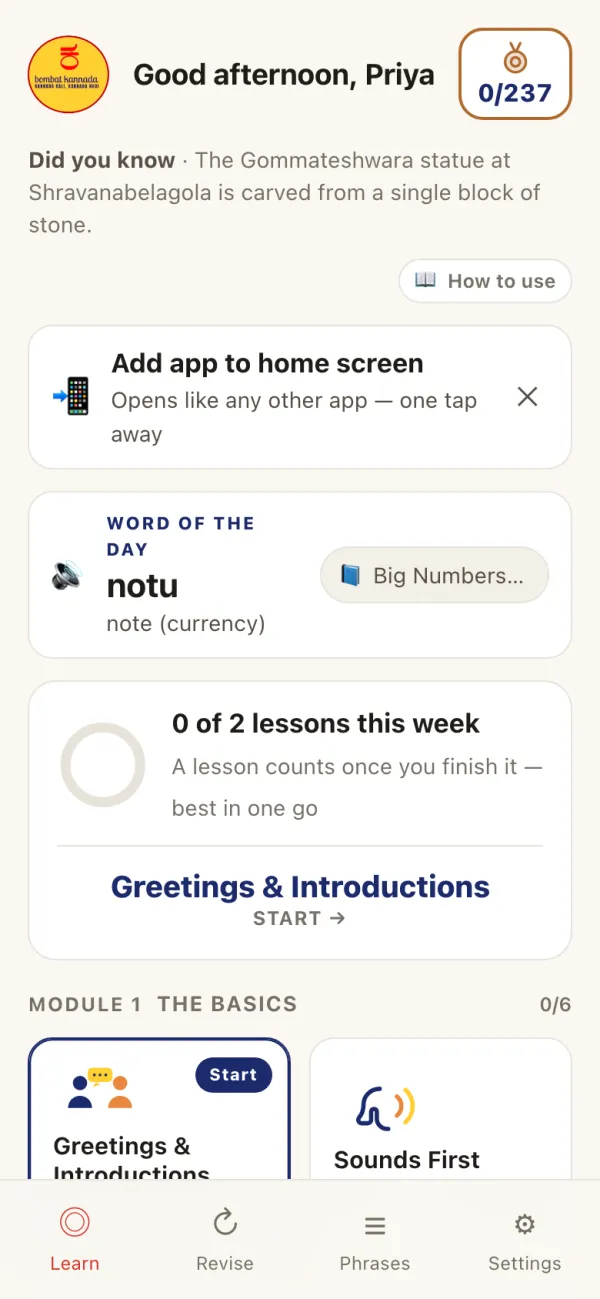
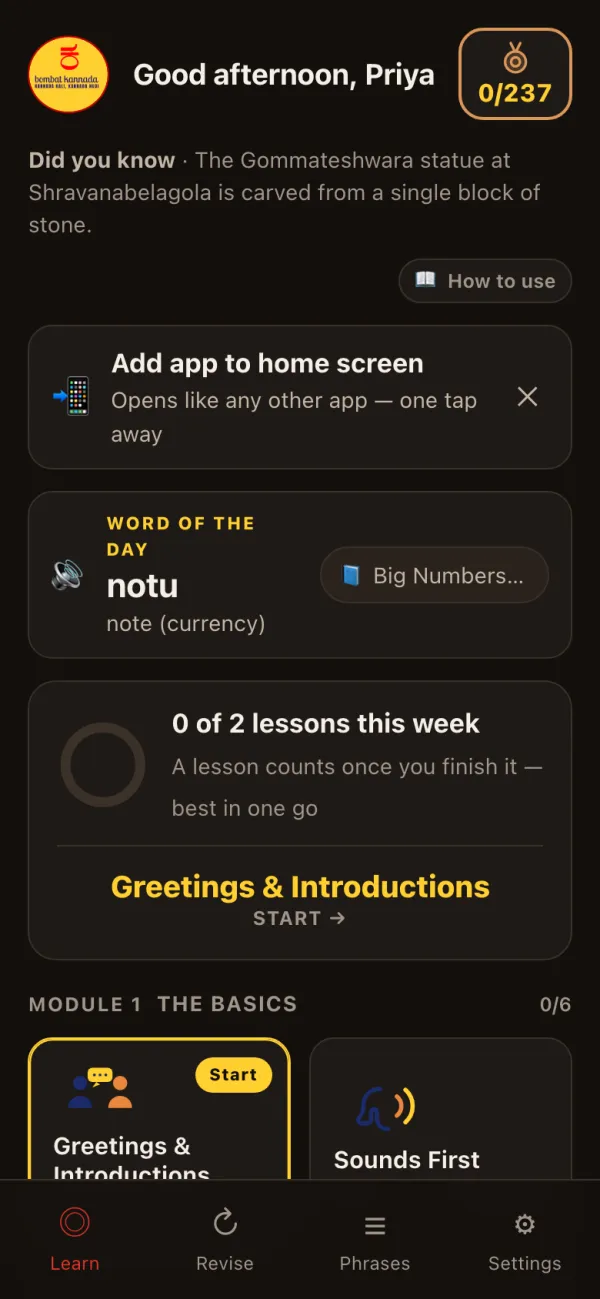
No script drills, no grammar tables to memorise. You hear real sentences first, then the words inside them, then the pattern that holds them together — and you say every line out loud.
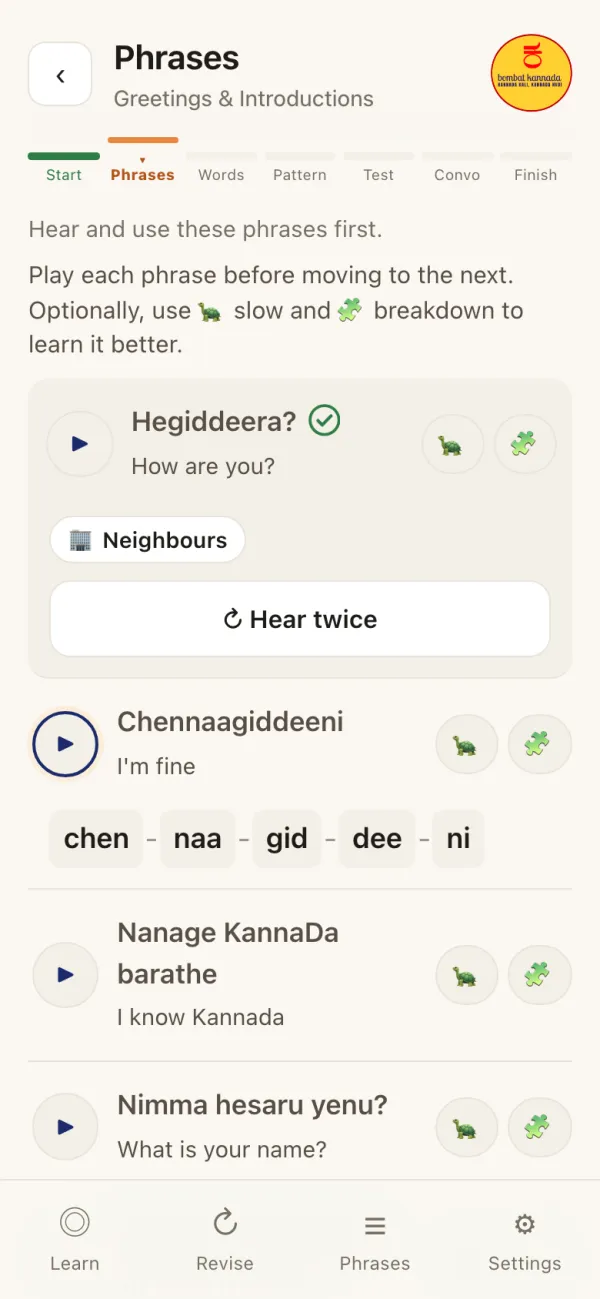
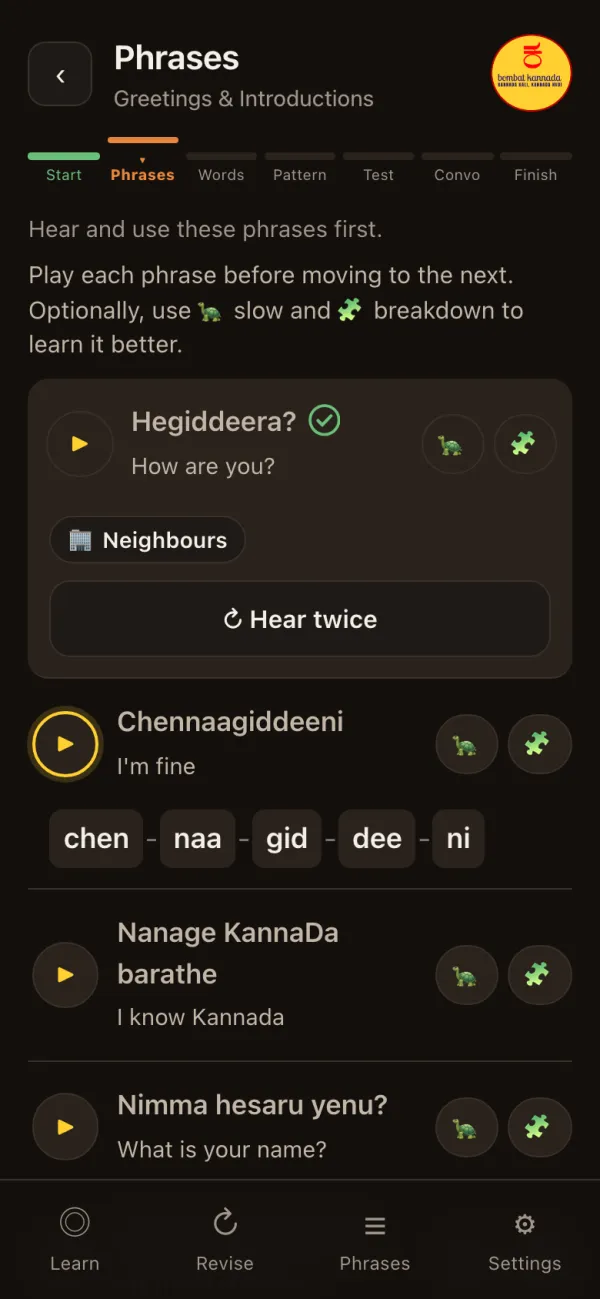
Every word and sentence has a recording behind it. Tap ▶ to hear it, 🐢 to hear it slowly, and 🧩 to hear it a syllable at a time until it sits in your mouth.
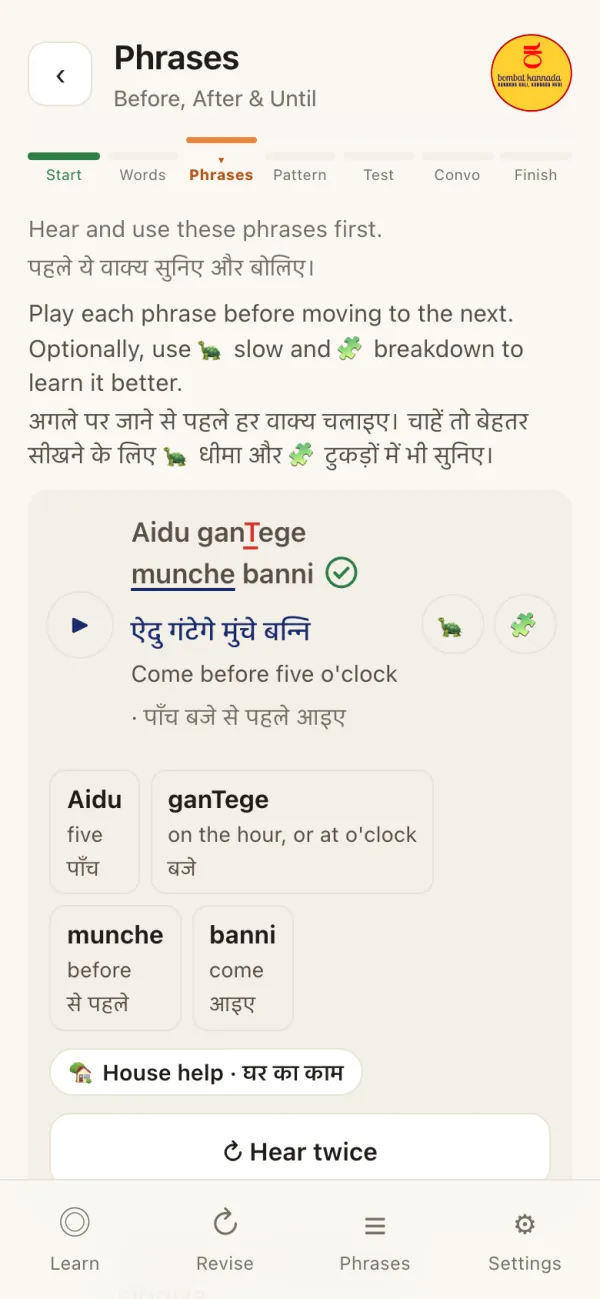
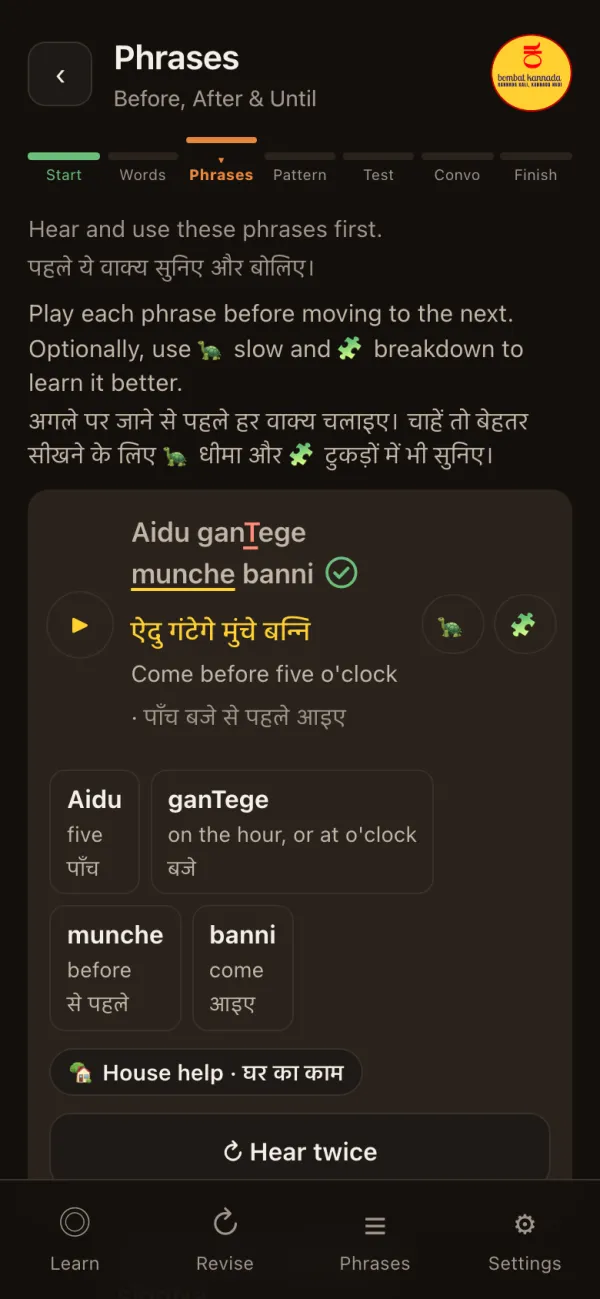
Open a line and each word shows its meaning. The tutor's voice says what each word means, then the whole sentence — the way an offline class would.
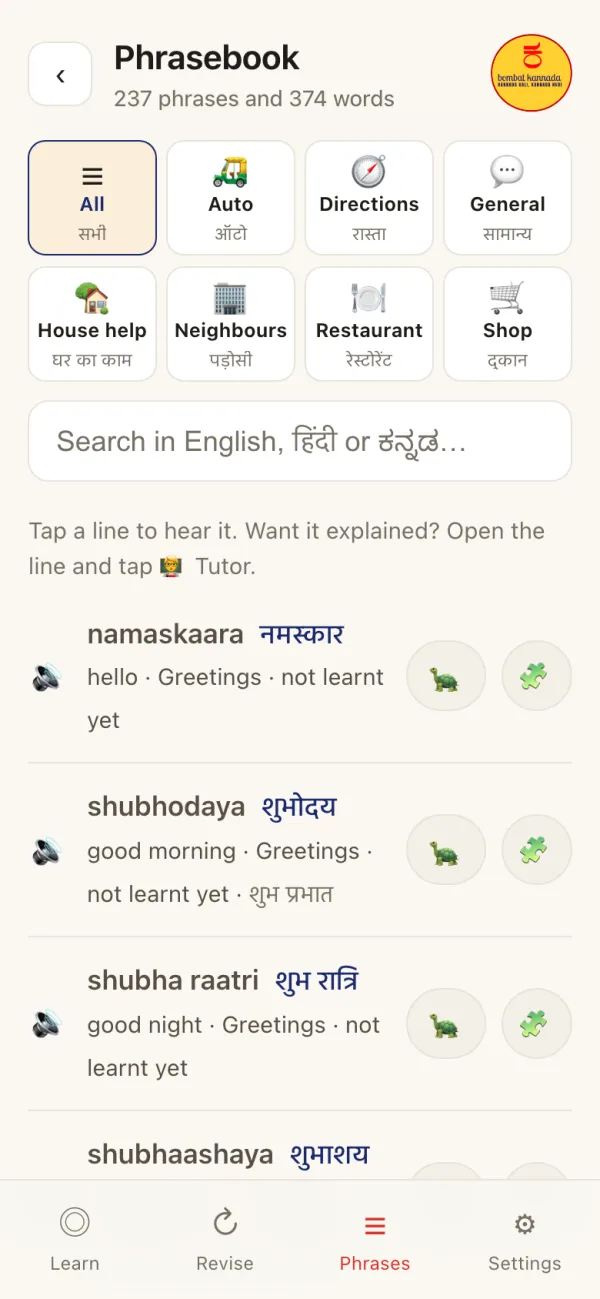
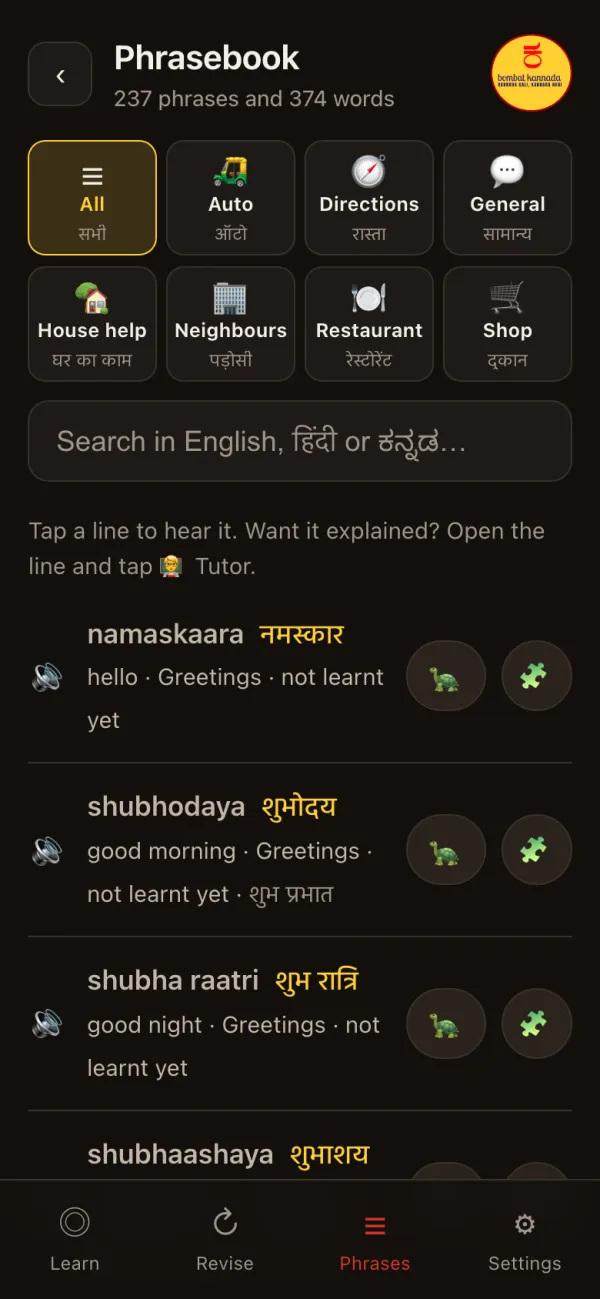
Turn Hindi on and every word shows its Devanagari spelling and Hindi meaning, and the tutor explains in Hindi. The Phrasebook searches in English, Hindi or Kannada, and groups lines by situation — Auto, Shop, House help.
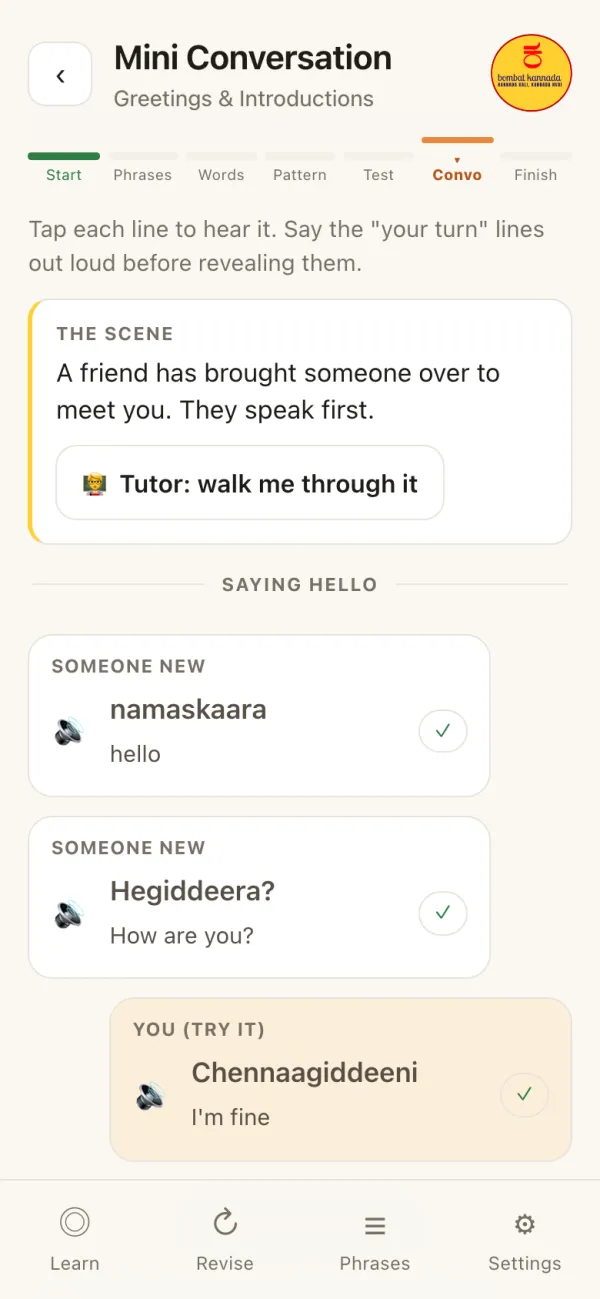
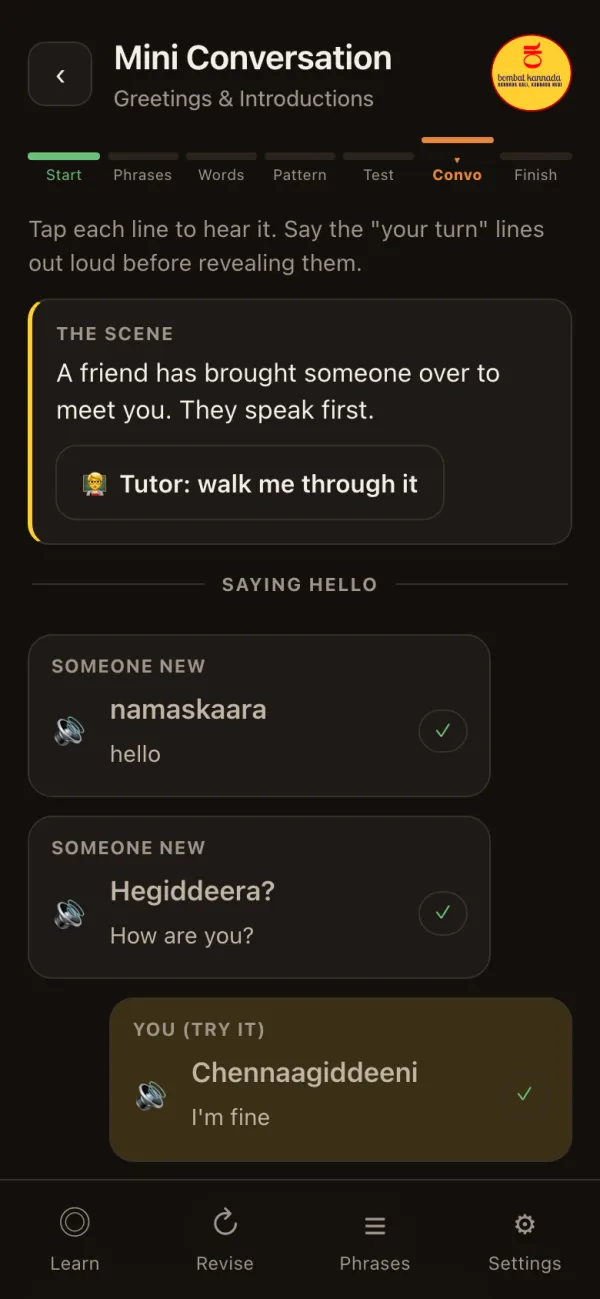
Every lesson ends in a short scene. They speak; on your turn you say the line out loud before you reveal it. Then the lesson gives you one thing to say to a real person.
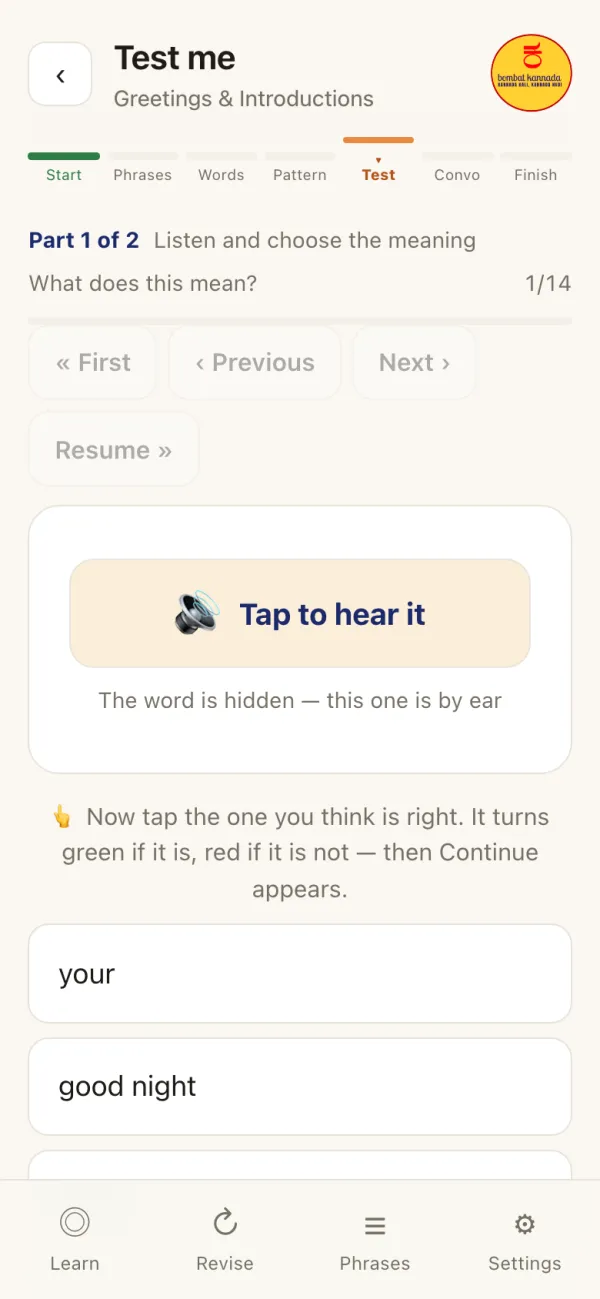
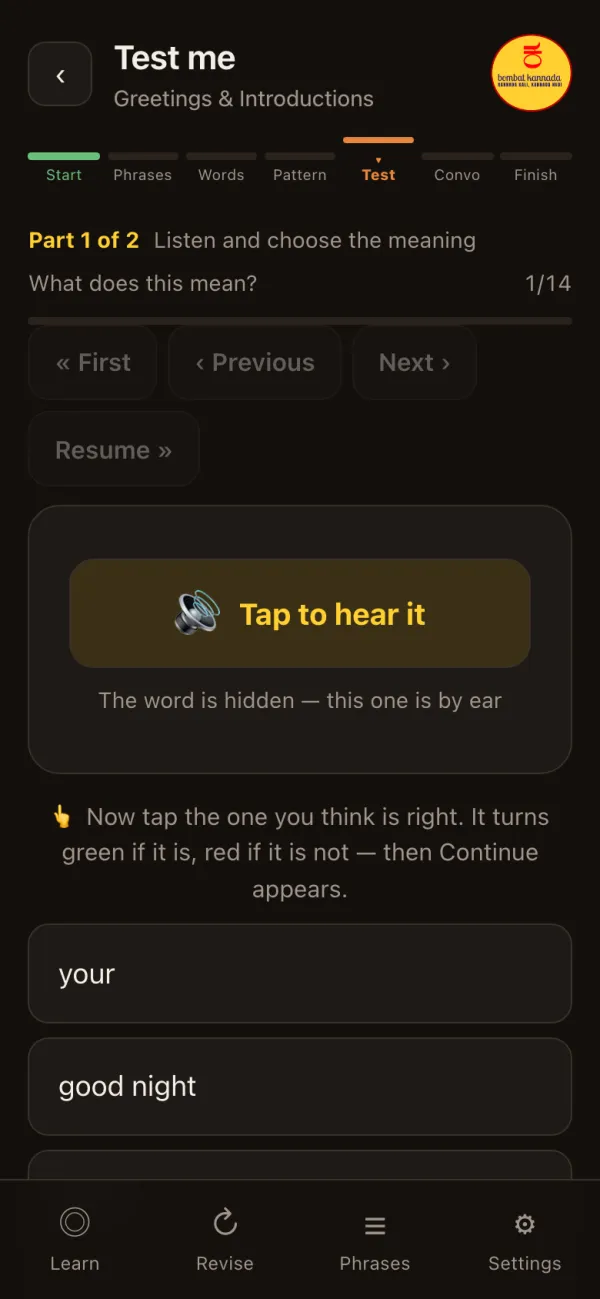
The word is hidden — you hear it and pick what it means. Tapping, never typing. Miss one and it simply comes round again.
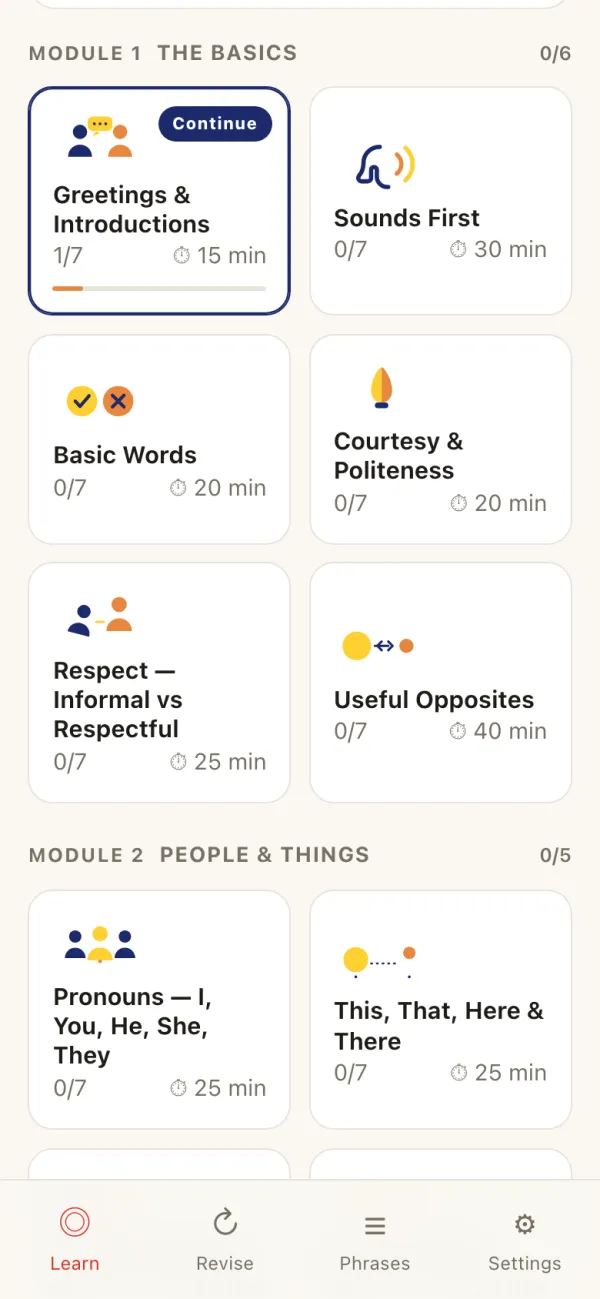
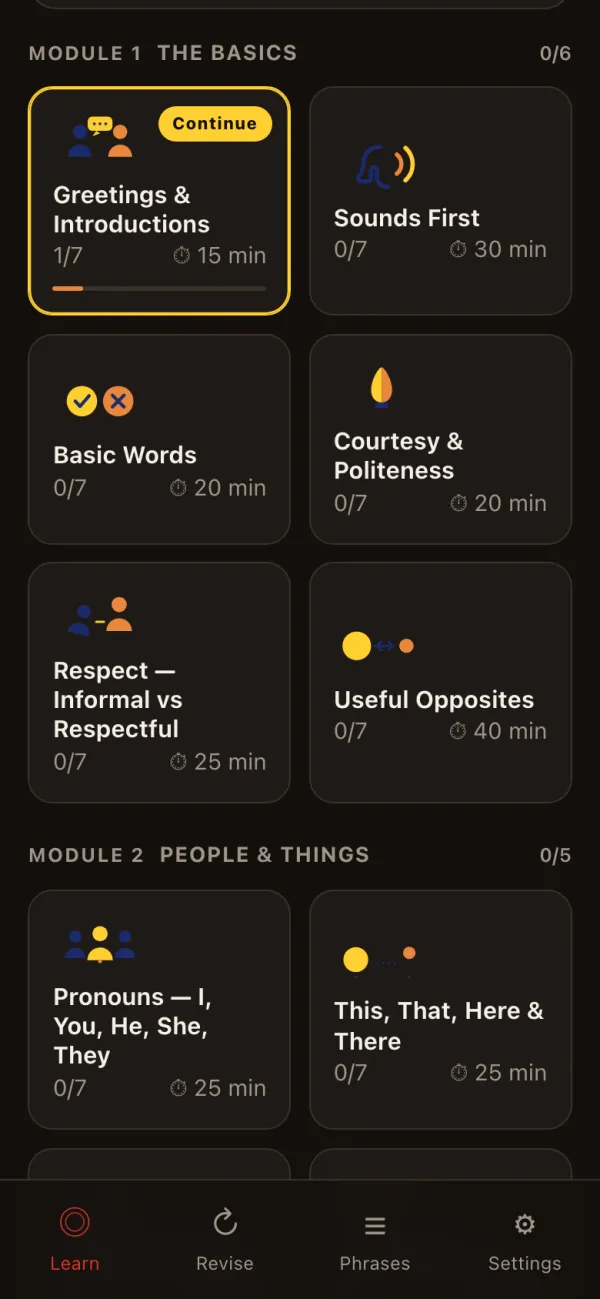
Modules in the order to do them — the basics, people and things, numbers and money, days and time, daily essentials, basic actions — with the next lesson always marked. The rest of the course arrives at launch.
How it works
Open app.bombatkannada.com on your phone and make an account. Turn Hindi on if it helps. Add it to your home screen.
15 to 45 minutes. Play every line, say it aloud at least three times, and Continue opens when your ears have been everywhere.
Every lesson ends with one thing to try on the watchman, the auto driver, whoever hands you your coffee. That is the lesson; the app is the rehearsal.
Pricing
Pre-launch version. Modules 1–6 are available now. The remaining modules are planned for launch in mid-January 2027. The launch date, the lessons planned for launch and pricing are tentative and may change.
Questions
Not yet — this is the pre-launch version. Modules 1–6 are available now, and the remaining modules are planned for launch in mid-January 2027. A plan bought now includes them as they are released. The launch date, the lessons planned for launch and pricing are tentative and may change.
No. Bombat Kannada is learned by ear. Every word is written in plain English letters (for example, namaskaara), and you are never asked to read or write a Kannada letter. If you read Hindi, you can also turn on Devanagari spellings.
Yes. Many everyday Kannada words are shared with Hindi or close to it. Turn Hindi on in Settings and every word shows its Devanagari spelling and Hindi meaning, and the tutor explains in Hindi. It is off by default, and you can switch it on or off at any time.
Spoken, everyday Kannada as it is heard in Bengaluru: at the auto stand, the vegetable cart, the apartment gate and the office. It is taught in many voices, on purpose, so your ear gets used to how different people actually sound.
The first modules are free, with no card needed. Pro unlocks the full course, including lessons added later, with one payment for the period shown on the pricing page. There is no automatic renewal, and there is a 7-day refund. See app.bombatkannada.com/pricing for the current price.
No app store needed. Open app.bombatkannada.com in your phone's browser and sign up. You can add it to your home screen so it opens like any other app: one tap on Android, and Share then Add to Home Screen on iPhone.
Most lessons take 15 to 45 minutes, and are best done in one sitting. You pick a weekly goal of two, four or six lessons, and the Revise tab brings words back just before you would forget them.
Bombat Kannada is made in Bengaluru by Tiramai HR Consulting Services LLP. Write to support@bombatkannada.com with anything.
Namaskaara — hello. That's one. The app has the rest.